
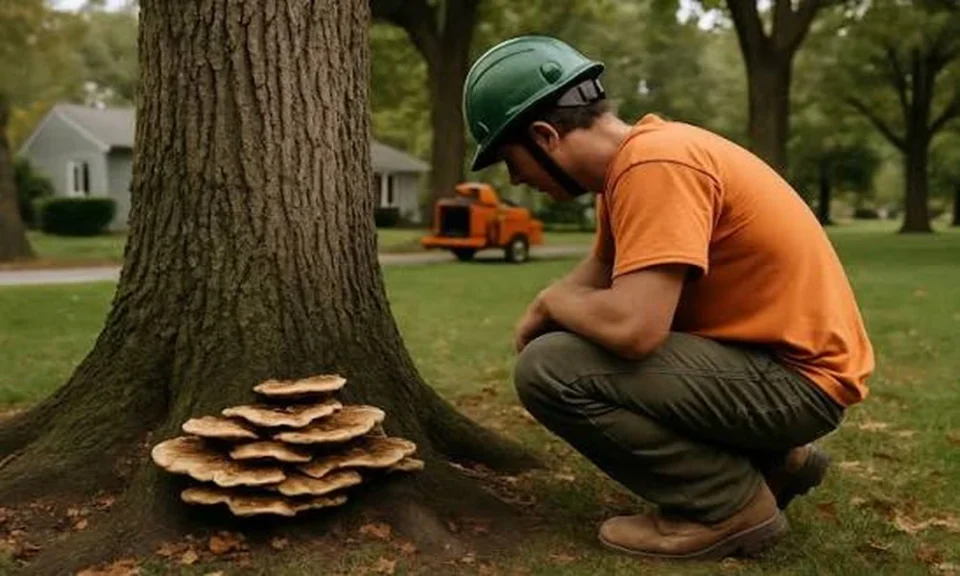
A tree rarely signals trouble in proportion to the actual danger. A torn limb hanging over the driveway looks urgent, yet it is often a contained problem with a simple fix. A ring of honey-colored mushrooms around the root flare looks harmless, and it can mean the roots holding the whole tree upright are already rotting. Reading the symptom correctly is what separates a pruning visit from a removal.
In the southern Willamette Valley this matters more than in most places. Douglas-fir, Oregon white oak and bigleaf maple grow very large on deep, wet soils. Winter brings saturated ground, strong wind events and the occasional ice storm. The same warning sign can mean different things depending on species, soil and season, so each scenario below pairs a symptom with its likely cause and the fix that usually follows.
Before anyone cuts, it helps to know the local rules. Under Eugene City Code section 6.305, felling more than five trees within 12 months on a private parcel of 20,000 square feet or more requires a permit. Street trees in the public right of way need city approval regardless of lot size, and the city can require a replacement tree or a payment to fund one. The code has exemptions for hazardous trees and many developed lots, so confirm with the city before assuming either way.
When the diagnosis points to removal, the hard part is often access. A big fir wedged between a house, a fence and an overhead service drop cannot be dropped in one piece. For Eugene Tree Removal, Purple Heart Tree Service brings a certified arborist and a journeyman powerline clearance tree contractor to the same job, plus crane-assisted lifts that take a tree down in sections without crossing the roof. The owner-operated crew answers calls around the clock and can finish with stump grinding and regrading, so the yard is usable once the tree is gone.
Mushrooms or Conks at the Base of a Fir
Symptom. Clusters of mushrooms appear at the root flare in fall, or shelf-shaped conks form on the lower trunk. The crown may look thin and yellow, and the tree may produce an unusually heavy cone crop.
Likely cause. Root disease. Laminated root rot is the most serious disease of Douglas-fir in the region. The PNW Plant Disease Management Handbook notes that decayed wood separates along the annual rings like pages in a book, and that infected trees often topple because most of their roots have decayed. Armillaria, another common culprit, leaves white fans of fungal tissue under the bark and resin bleeding near the base. OSU Extension points out that root diseases usually spread root to root, so they tend to show up in patches rather than single trees.
Fix. An arborist assessment, sometimes with soil excavation at the root collar or decay testing. A confirmed infected tree within striking distance of a house usually comes down. Nearby firs deserve a closer look too, and replanting with hardwoods or pines, which resist laminated root rot, breaks the cycle.
A Crack Running Down Between Two Stems
Symptom. After a windstorm or ice load, a crack opens where two trunks meet, and one side starts to sag.
Likely cause. A codominant union with included bark. When two stems of similar size grow tightly together, bark gets trapped between them instead of forming solid connecting wood. The joint looks strong for decades, then fails under a heavy load.
Fix. Once the union has opened, cabling rarely makes it safe again. The failed stem usually comes off, and often the whole tree follows. If a similar union on another tree has not cracked yet, crown reduction and supplemental cabling can cut the load before it fails. A split tree also holds stored tension, so it is not a homeowner chainsaw job.
Roots Lifting a Slab, Walkway or Foundation
Symptom. A patio heaves, a sidewalk panel tilts, a foundation crack shows up near a large tree, or drains slow down every fall.
Likely cause. Roots follow moisture and oxygen. They thicken under slabs where water collects, and they enter sewer lines through loose joints. Near foundations, the tree is often exploiting a crack that already existed or drying out clay soil, rather than shoving concrete aside.
Fix. Cutting big roots close to the trunk can destabilize the tree, so the decision belongs with an arborist. Sometimes root pruning on one side plus a root barrier works. When it does not, removal, stump grinding below grade and regrading so water drains away from the house solve the problem together.
A Straight Tree That Suddenly Leans
Symptom. A tree that always stood upright now tilts after days of rain. The soil on the side opposite the lean is cracked, mounded or lifting.
Likely cause. The root plate is pulling out of saturated ground. This is very different from a tree that has leaned for years and curved its top back toward vertical, which has usually adapted and may be perfectly stable.
Fix. Treat it as an emergency. Keep people and vehicles clear and call for help the same day. A tree in this condition is rarely salvageable.
A Dead Top With Pitch Streams or Sawdust
Symptom. The top of a fir browns out after a dry summer. Resin streams run down the bark, and reddish boring dust collects in the bark crevices or around the base.
Likely cause. Drought stress followed by bark beetles. Beetles target weakened trees, and those already struggling with root disease are especially vulnerable.
Fix. Infested trees are generally removed before the next generation of beetles emerges in spring. Do not stack freshly cut fir rounds next to living firs, because downed wood can act as a breeding site.
A Broken Limb Resting Near Power Lines
Symptom. A hanging or broken branch rests on or near a service drop or distribution line.
Likely cause. Storm breakage, often on limbs that grew back too close to the lines after earlier trimming.
Fix. Stay away and call the utility. Federal OSHA rules limit work near energized lines to qualified line-clearance workers. Even a dry branch can conduct electricity when it is wet or touching other limbs.
Across all six scenarios, timing tells you a lot. Note when a symptom first appeared, whether it follows a season, and whether nearby trees show the same signs. Those few details often settle the diagnosis faster than any single photo of the trunk.
