
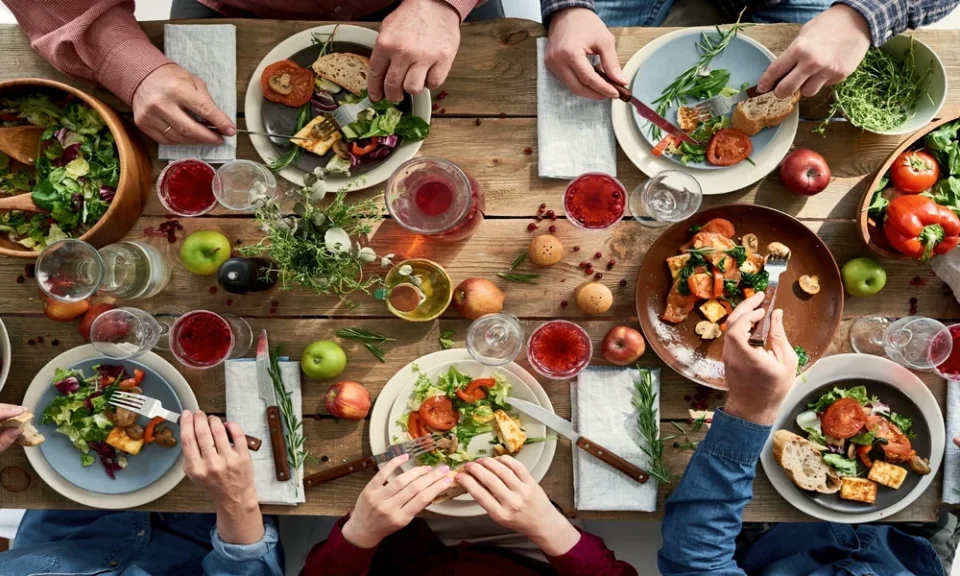
Sixty guests is the number where hosting stops being a dinner party and starts being a logistics job. I learned that the hard way at a family reunion where I volunteered to handle food for 55 relatives and ended up eating cold rice standing at the sink while everyone else had a lovely time. The problem wasn’t the cooking. It was that I spent three weeks deciding between chicken and beef instead of deciding how the food would actually move from a kitchen to fifty-five plates.
Group feeding runs on four decisions, made in the right order: headcount, format, service, and timing. Get the sequence right and the rest falls into place. Get it wrong, and you’ll be reheating trays at 9 p.m. while your guests wonder where the birthday cake went. When you price out something like seafood catering services, you’re not just buying food, you’re buying back the hours you’d otherwise spend shopping, prepping, and guessing at portions.
Here’s the thing nobody tells you before their first big event: the guest count you ballpark at the
start is almost never the guest count that shows up. Roughly 85 to 90 percent of invited guests attend a typical casual event, and the percentage drops with distance and rises with closeness, so a party full of local friends and family will run closer to the top of that range. If you want something more precise than a gut feeling, the U.S. Census Bureau has household and population data that can help you sanity check regional habits around group gatherings.
Pick the format before you pick the menu
Most hosts do this backward. They choose a menu first, then discover that their menu doesn’t survive sitting out for three hours or needs eight separate cooking vessels while they’re also greeting guests. Format comes first: is this a seated meal, a buffet, a grazing spread, or a hands-on communal thing where people crack their own shells and make a mess?
Hands-on formats are the friendliest for big groups, because they turn the meal into the activity and let people serve themselves at whatever pace they want. Buffet-style and communal boil-style spreads also let you feed an extra few people without anyone noticing, since portions aren’t pre-plated. Seated meals, meanwhile, demand tighter portion math and more staff. If your guest list crosses the sixty mark, hands-on almost always wins.
How many pounds of food per person, really?
The standard rule for a buffet is about one to one and a half pounds of food per guest per meal, spread across proteins, sides, and bread. But that number swings wildly depending on your crowd. A table of teenagers will clear a tray that a table of retirees won’t touch. A midday brunch eats lighter than an evening dinner. And a menu built around shells and bones needs a higher raw weight, because guests get a lower yield per pound once the shells come off.
My rule, tested across a dozen events: plan for one and a half pounds per adult for dinner, one and a quarter for lunch, and add two extra servings of each side as buffer. Buffers save you from panic runs to the store. Nobody has ever complained about leftover bread.
Service logistics you’ll forget until it’s too late
Food service is where group events break, and the failure points are boring. Where will guests put their plates? How many trash bins do you need if every guest generates two or three plates of debris from shell-on seafood? Where do wet wipes and napkins live? Do you have enough surface area, or will people be balancing plates on their knees?
The U.S. Small Business Administration publishes event and operations planning guidance for hosts and small operators, and its checklists around site setup and crowd flow translate well to private events. Walk through the space as if you were a guest arriving hungry: where do you enter, where do you set down your plate, and where do you go to wash your hands?
Timing beats perfection every single time
The best moment for food to land is 20 to 30 minutes after your stated start time. Early food sits and cools. Late food makes guests restless and hungry, which is the fastest way to sour a party mood. If your caterer delivers, confirm the drop time and ask how long items hold before quality drops. Some foods peak for an hour, some hold for three. Knowing which is which lets you schedule eating around the food instead of the other way around.
Also build in a 30-minute buffer before your first guest arrives for setup errors. Something always goes sideways. Someone always forgets forks. The Centers for Disease Control and Prevention publishes general food safety guidance for keeping hot foods hot and cold foods cold during events, and it’s worth a five-minute read before you serve anything that’s going to sit out for a few hours.
A simple pre-event checklist
- Confirm final headcount 72 hours out, then add 5 percent buffer
- Match format to guest count: seated under 30, buffet and communal over 30
- Calculate food weight based on time of day, crowd age, and shell-on yield
- Walk the serving space with a plate in your hand, twice
- Confirm delivery time, hold time, and reheat instructions with your caterer
- Assign one person to garbage, one to drink refills, one to welcome
Notice that the list has no menu items on it. That’s on purpose. The menu is the fun part, and it’s also the part that matters least once you’ve solved format, quantity, service, and timing. You can swap a menu the week of an event. You can’t swap the layout of a room or the flow of guests through a buffet line after people have arrived.
If the guest list is heavy with people you actually like, and you want to be present for the party instead of stuck in the kitchen, outsourcing the food is the highest-leverage decision you can make. The money you spend on prepared food buys you the one thing you can’t get back at a large gathering: your own time with your guests.
